
Sandy Springs, GA · Garage Door Service
What That Garage Door Noise Is Actually Telling You
Grinding, popping, or banging garage door in Sandy Springs? Here's what each sound usually means in homes built from the 1950s through the 2000s, and when to call.
- Repairs & new doors
- Springs & openers
- Serving 8 nearby communities
Leaving It Alone
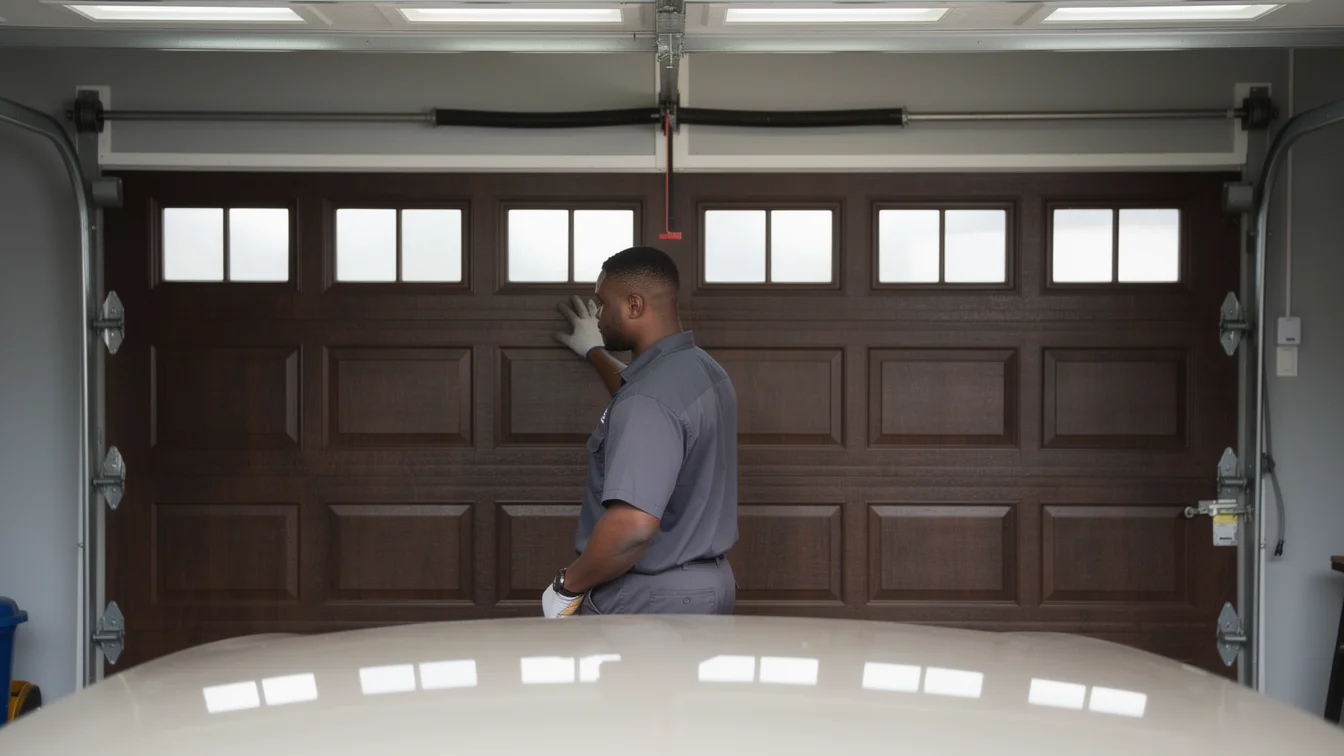
Not every sound needs a truck. A door that groans once at the start of the lift cycle and then runs quiet is usually just a dry hinge or a roller that needs grease, especially in homes built in the 1980s and 90s, which make up most of the stock across this service area. That era of door came with steel rollers on steel track, and steel on steel squeaks long before it fails.
A light rattle on a windy day, or a track that ticks as the door closes, is often just thermal movement. Sandy Springs sits in a cold-moderate climate band, which means the metal track and torsion bar contract in winter mornings and expand again by afternoon. That tiny flex makes noise without meaning anything is wrong.
What you can leave alone: single squeaks that don't repeat, noise that only happens on the coldest mornings, and a door that still opens and closes level. What you shouldn't leave alone: a noise that gets louder over a week, or any noise paired with the door catching or jerking partway through its travel. That combination usually means a spring or cable is starting to go, and it won't fix itself.
The Cost of This Job
We don't post a flat number here because the fix depends entirely on what's making the noise. A dry hinge is a five-minute lube job. A worn roller set on a door that's been banging for months is a bigger ticket, and if the noise turns out to be a torsion spring losing tension, that's a different repair than a cable fraying at the drum.
What we can tell you honestly: on homes from the 1951-2007 build range that make up this area, with a median build year around 1980, the torsion hardware is often original or a single replacement generation old. If a spring on that hardware is the one making the noise, replacing it as a matched pair on a double door is standard practice, not an upsell, because a single new spring paired with an old one wears unevenly and comes back to the same noise in under a year.
The honest limitation: we don't quote spring or opener gear replacement over the phone based on a noise description alone. Too many different problems sound alike through a phone call, and guessing wrong wastes your time and ours.
The Situation
Across the roughly 66,165 owner-occupied houses in this area, the doors in daily use split pretty evenly between original 1980s-90s hardware and newer replacements installed in the last couple decades. The noise profile is different for each.
On the older stock, the sound to listen for is a rhythmic thunk on each rotation of the torsion shaft, which usually means a spring coil rubbing against itself or the shaft starting to wear its bearing plate. These doors have had decades to accumulate small amounts of play in every joint, and the noise is often the first warning before a cable jumps its drum.
On newer installs, grinding or a high-pitched whine more often points to the opener's drive gear, not the door hardware itself. Belt-drive openers installed in the last 10-15 years wear differently than the chain-drive units common on older homes, and a whine that rises and falls with opener speed is a gear issue, not a spring issue. Knowing which decade your door and opener came from narrows the diagnosis before anyone touches a tool.
How Local Conditions Play In
The cold-moderate climate here means the hardware goes through a real seasonal cycle, even if it's nothing like a true winter climate further north. Metal track brackets loosen slightly as the temperature swings through fall and spring, and a bracket that's a quarter-inch off plumb will tick every time the door passes it.
Humidity swings matter too for anything wood-adjacent, like door panels with wood trim inserts common on homes from the 1980s and 90s. Panels that have absorbed moisture over a humid stretch and then dried out can develop a faint creak at the hinge line that has nothing to do with the hardware at all.
We work across this side of the metro, from homes near Perimeter Center out through Chastain Park, Brookhaven, and North Buckhead, and the noise patterns repeat house to house once you know the build era. A door that's quiet in July and noisy every January, in a home from that original construction wave, is telling you something specific about how its hardware ages here, not a random defect.
Frequently asked questions
My garage door makes a loud bang when it closes. Is that serious?
A single bang on closing, especially on an older door, often means a cable has slipped on its drum or a hinge has worked loose. It can also mean a spring is close to failing. Don't run the door again until someone's looked at it, since a spring letting go under tension is a real injury risk.
Why does my door only squeak in the morning?
Cold mornings tighten the metal in the track and torsion bar slightly, which is common in this climate band. If the squeak disappears once the door warms up and runs a few cycles, it's usually just that seasonal contraction, not a failing part. If it persists all day, treat it as a separate issue.
Is it worth replacing an old noisy opener or just fixing it?
Depends on the gear. If the drive gear is stripped on a chain-drive unit common to older homes here, replacing just that gear is often cheaper than a new opener. If the noise comes with intermittent failures to respond to the remote, the circuit board is likely going too, and that's when replacement usually makes more sense than repair.
Related garage door services in Sandy Springs
More garage door guides
Book garage door service in Sandy Springs
Call now or request a quote - tell us what the door is doing and where you are.