
Sandy Springs, GA · Garage Door Service
Garage Door Roller Replacement, Sandy Springs
Worn or cracked rollers on 1980s-era Sandy Springs garages bind and jump track in cold snaps. Here's what the repair involves and when it's worth doing yourself.
- Repairs & new doors
- Springs & openers
- Serving 8 nearby communities
What the Fix Involves
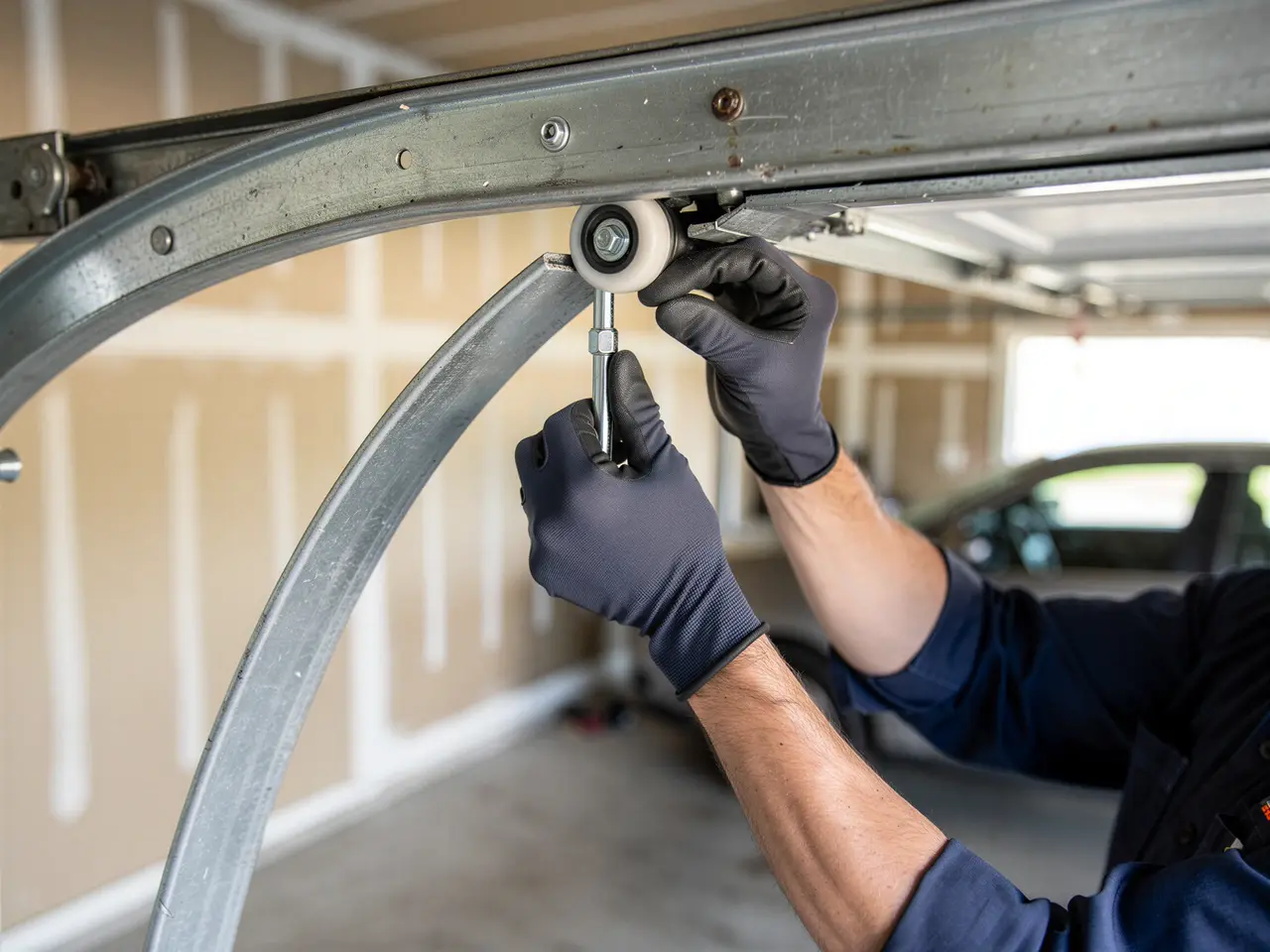
Roller replacement is a hardware swap, not a door replacement. We pull the old rollers out of the hinges and track brackets one at a time, working top to bottom so the door stays supported on its cables the whole time. On most homes built here between 1951 and 2007 - with the bulk of the stock dating to the 1980s and 90s - the original hardware is steel rollers riding directly in a stamped track, no nylon, no sealed bearing. Thirty-plus years of that steel-on-steel contact wears a groove into the roller wheel and roughens the track rail at the same time.
We typically swap in sealed nylon rollers with a ball-bearing stem. They run quieter, don't need the periodic lubrication steel rollers demand, and hold up better through repeated freeze and thaw than bare steel does. If the track itself has worn unevenly from years of riding on grooved rollers, we'll flag that separately - a track that's bent or scored doesn't get fixed by new rollers alone, and we're not going to sell you rollers if the real problem is the rail.
A full set is usually ten rollers per door, plus a check of the hinges they seat in, since a bent hinge wears out a new roller just as fast as it wore out the old one.
The DIY Question
Replacing the two or three rollers at the bottom of the track is a reasonable DIY job - low leverage, low spring tension nearby, and the hardware is cheap. Replacing rollers higher up the track, especially the ones near the top fixture or anywhere close to the torsion spring and cable drums, is a different job. The door is heavier than it looks once it's off its rollers mid-swap, and a slipped cable under tension is how people get hurt.
Our honest take: if you're comfortable with a ladder and basic hand tools, swapping the bottom two rollers on each side is within reach. Anything above that, or any job where you're also noticing a stiff spring or a cable that looks frayed, we'd rather you call than improvise. We don't charge extra to also check the spring while we're in there - it's one visit either way.
What Causes It Around Here
Sandy Springs sits in a cold-moderate climate band, which means real freeze-thaw cycles each winter rather than constant deep freeze or none at all. That cycling is hard on steel rollers specifically: condensation forms inside the track overnight, the metal contracts in the cold, and the roller wheel picks up pitting faster than it would in a climate that stays either consistently warm or consistently frozen.
Pair that with the age of the housing stock - a median build year of 1980, with most of the area's 28 named neighborhoods built out through the 1980s and 90s - and you get a lot of doors hitting the 30-to-40-year mark on original hardware at roughly the same time. We see the same pattern across this part of the service area: steel rollers that have outlasted a couple of openers already, now grooved enough that the door shudders at the top and bottom of travel. It's wear, not a defect, and it shows up on schedule.
How It Shows Up
The first sign is usually sound, not sight - a rhythmic clunk or squeal as the door travels, timed to how many rollers have gone bad. A grinding or grating noise, worse in cold weather, points to a roller that's lost its wheel surface and is now riding on the bare stem. Visually, look for a roller that's flat on one side, or a track with a shiny worn groove where a bad roller has been riding off-center.
If the door starts to jump slightly at the horizontal curve of the track - the spot where it transitions from vertical to horizontal - that's often a roller too worn to hold the curve smoothly anymore. Left alone, a bad roller eventually binds hard enough to stall the opener or pop out of the track entirely. Caught early, it's a straightforward swap. Caught late, you're also replacing a bent track section, which is a longer job and a different bill.
Frequently asked questions
How many rollers does a typical garage door need replaced at once?
Most doors in this area run ten rollers, and we recommend doing the full set rather than just the worn ones. The remaining steel rollers are usually close behind in wear, and replacing them together means one visit instead of two over the next year or so.
Will new rollers fix a noisy garage door completely?
Often yes, if the rollers are the actual source of the noise. But a noisy door can also mean a dry hinge, a loose track bracket, or an opener chain needing tension. We check all of it during the visit rather than assuming rollers are the only culprit.
Do nylon rollers really last longer than the original steel ones here?
In this climate, yes. Sealed nylon rollers don't pit the way bare steel does through repeated freeze-thaw cycles, and they don't need the periodic oiling steel rollers require to avoid that wear in the first place.
Related services
By Neighborhood
Roller Replacement across the Sandy Springs area
We also handle roller replacement in these Sandy Springs-area suburbs.
Book garage door service in Sandy Springs
Call now or request a quote - tell us what the door is doing and where you are.